Stamps Printed by Thomas de la Rue Ltd in Great Britain
from 1869 Onwards
Internal Revenue
Stamps
As with Bills of Exchange stamps, these were first introduced in 1869. There were, however, no locally-printed issues involved, the first coming from De La Rue. Prior to these arriving from Britain, it appears that postage stamps may have b een used for internal revenue purposes. There are eight such stamps listed on page 82 of Morley's 1910 catalogue, where he states "This set is catalogued by Moens, but no copies can be traced". Barefoot does not include them, and I have never seen the Moens listing. Neither have I ever seen a stamp with an obvious fiscal cancel from these Victorian issues. One must assume that copies are extremely rare that they just do not exist.
Governments found Internal Revenue stamps a very
convenient form of tax collection, with administrative costs being kept
to the minimum. They were used for a variety of purposes. Some of these
are listed below, although this list is not necessarily exhaustive.
Where known, Sterling price of the stamp required is shown in brackets
after the heading. In cases where no value is shown, ad valorum duty was
paid in most cases.
BILL OF LADING
This is a legal document between a shipper of a particular commodity and
the carrier detailing the type of goods, the quantity and the
destination. It also serves as a receipt of the shipment when the goods
are delivered to the prescribed destination.
PATENTS FOR INVENTIONS
Such a document would convey upon the patentee the exclusive right to
prevent others from making, using or selling and distributing the
patented invention without permission.
DEBENTURE AND SHARE CERTIFICATES
A debenture is normally issued by a company, in the form of a
certificate of indebtedness by the company, to the owner of the debt. It
will often contain express provisions regarding the payment of interest
and the date on which the debt is to be repaid. Usually, a debenture can
be transferred from one owner to another. A share certificate recognises
that the holder owns a share of a company. Again, this is transferable
from one owner to another.
CHARTER PARTY (Two shillings)
This is a contract between the owner of a vessel and the charterer for
the use of a vessel. The charterer takes over the vessel for either a
certain amount of time (a time charter) or for a certain point-to-point
voyage (a voyage charter). These are the two main types of charter. The
phrase “Charter Party” is derived from the Latin charter partite, a
legal paper or instrument divided i.e. written in duplicate so that each
party retains half.
DOCK WARRANT (Four shillings)
In law, this is a document by which the owner of a marine or river dock
certifies that the holder is entitled to goods imported and warehoused
in the docks.
PASSPORT (Four shillings)
As everyone knows, this is a document to enable free passage from one
country to another. What is not so well-known is that some which were
produced in earlier times, including those in Mauritius, required a
Revenue stamp affixed as evidence of the duty paid to obtain the
passport in the first place.
OATH OF NATURALISATION (One pound)
The description of this oath has various titles in different parts of
the world. It is now generally known as the Oath of Allegiance and
Pledge of Loyalty. A person cannot be registered or naturalised as a
citizen of certain countries unless he or she has made the relevant
citizenship oath and pledge at a citizenship ceremony.
SURVEY REPORT ON SHIPS ( One shilling)
Such a Report would usually be conducted by a qualified Marine Surveyor.
Typically, this would include the structure, machinery and equipment and
general condition of a vessel. It is often closely associated with
marine insurance.
BOTTOMRY BOND (Three shillings)
This is a type of merchant funding using a ship as security for a loan,
which may be needed to finance a voyage, to deal with urgent repairs or
for some other emergency. Their use declined during the nineteenth
century, and they are no longer utilised.
SECURITY BOND AGAINST A BREACH OF LAW (Five shillings)
This could arise where bail was given to an offender.
LEGALISATION OF SIGNATURE (Ten shillings)
This was done by Statutory Declaration to the Supreme Court of
Mauritius, if it was necessary to prove that a signature was genuine.
There are two examples of the type of document involved that are
described later in this section on Internal Revenue stamps.
FOREIGN BILL OF EXCHANGE
It is surprising to find this heading here, in view of the fact that
Bills of Exchange stamps were specifically designed for this purpose.
However, it is quite clear that Internal Revenue stamps were permitted
to be used, as will be seen later.
CERTIFICATE OF CLEARANCE
Such certificates were issued by the Mauritian Collector of Customs for
the clearance of ship's cargoes. An example is shown later in this
section.
Out of all the applications shown above, I have only seen Internal
Revenue stamps genuinely used on legalisation of signature documents ,
Bills of Exchange and Certificates of Clearance.
The first issue of Internal Revenue stamps in 1869/72 were, as usual,
preceded by De La Rue proofs. Two of these are shown on
Plate 39.
The first is a composite, partly hand-painted essay in an unadopted
purple shade. An enlargement of the original is also shown to indicate
the full details of the artist’s work. Everything is hand-drawn or
painted with the exception of Queen Victoria’s head. No value tablet has
been added because this would be separate die. The patterns were also
not adopted, and the value tablet has pencil “scribble” to simulate
burelage.This word is of French origin, and refers to an intricate
network of fine lines, dots or other designs printed over or as a
background of some stamps to prevent forgery.
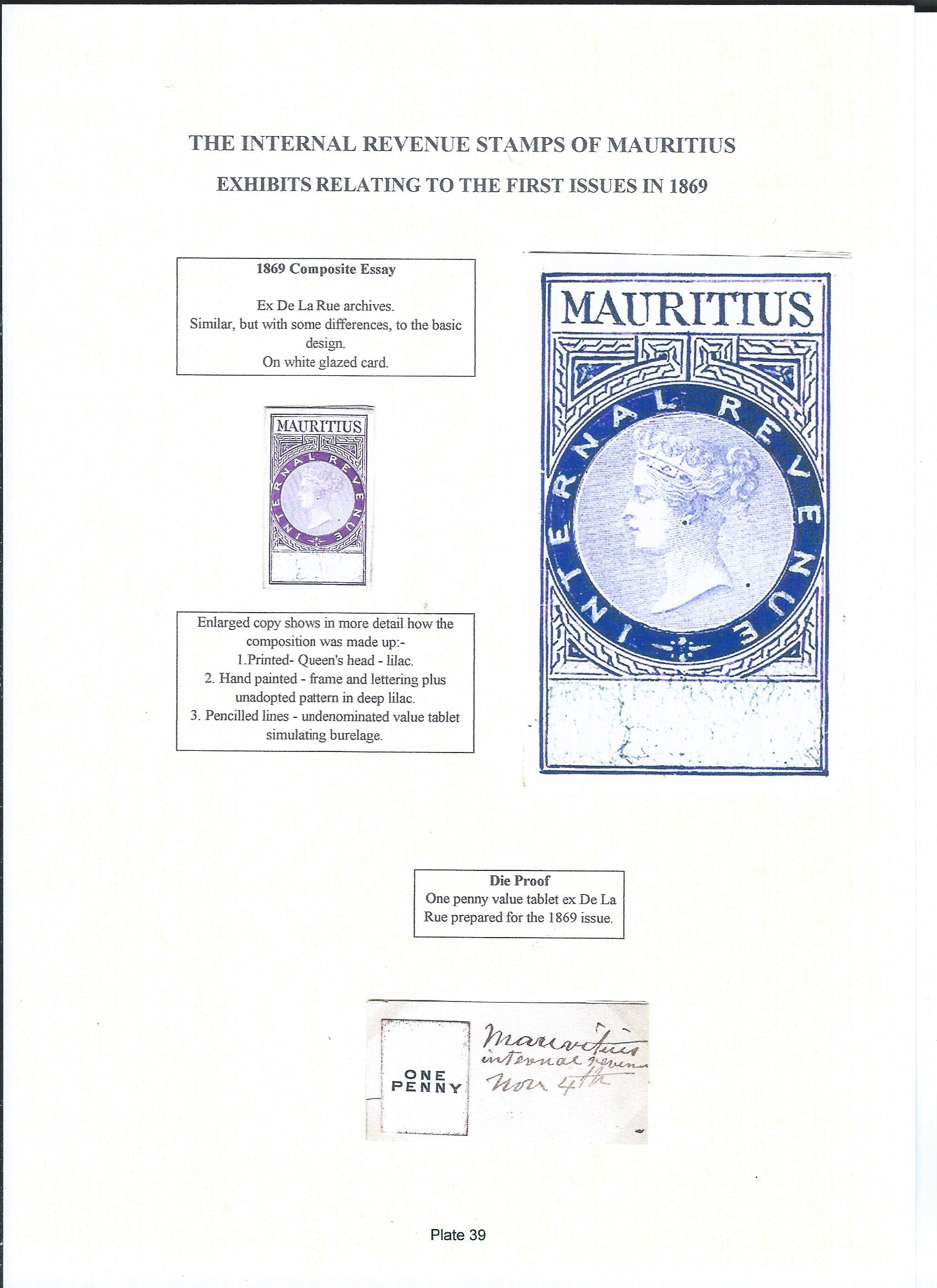
Plate 39 (click to
enlarge)
An example of a die proof value tablet is also shown on the same plate.
This is for the one penny value and is printed in black, whereas the
finally-issued stamp shows the value in blue. The proof has been pasted
onto card, on which the words “Mauritius internal revenue Nov 4th”
appear in manuscript.
Plate 40 displays a number of more advanced proofs in
different forms. There are six proofs in total, and all show the final
design including the burelage which was only simulated on the previous
Plate. The first two stamps on the Plate are mounted on card without any
values being shown. They are mounted on black card, which appears to be
somewhat fugitive, because the colour overflows slightly onto the stamp
itself. They are both overprinted “SPECIMEN”- Samuel type D7. The next
four are on paper and are all in final colours of the values displayed.
The two pence blue and blue, the one pound mauve and brown and the five
shillings brown and purple are imperforate, but the two shillings is
perforated 14. All except the five shillings have the Samuel type D7
overprint.
Copies of the actual De La Rue issues of 1869/72 Internal Revenue stamps
are shown on Plates
41 and
42. Rather like the early
primitives, the mint items are much harder to obtain, and only two are
shown here - the one penny and the threepence. Apart from the one pound
issue, the others are rather dull productions and unlike the later, more
adventurous De La Rue attempts. This may, of course, have been
influenced by the Crown Agents for the Colonies who were the final
arbiters on design and colour.
I mentioned earlier that Internal Revenue stamps are also permitted to
be used on Bills of Exchange. Plates
43 and
44 show an
example of this. The first Plate displays the front of the Bill which is
for £500 and is affixed with two Internal Revenue stamps for a total of
two shillings and sixpence. This is the correct tax charge for a Foreign
Bill of Exchange drawn in, but payable out of, Mauritius (see Plate 7
table of rates). the strange curly manuscript used to cancel the stamps
is also repeated against the drawer's name on the Bill itself.
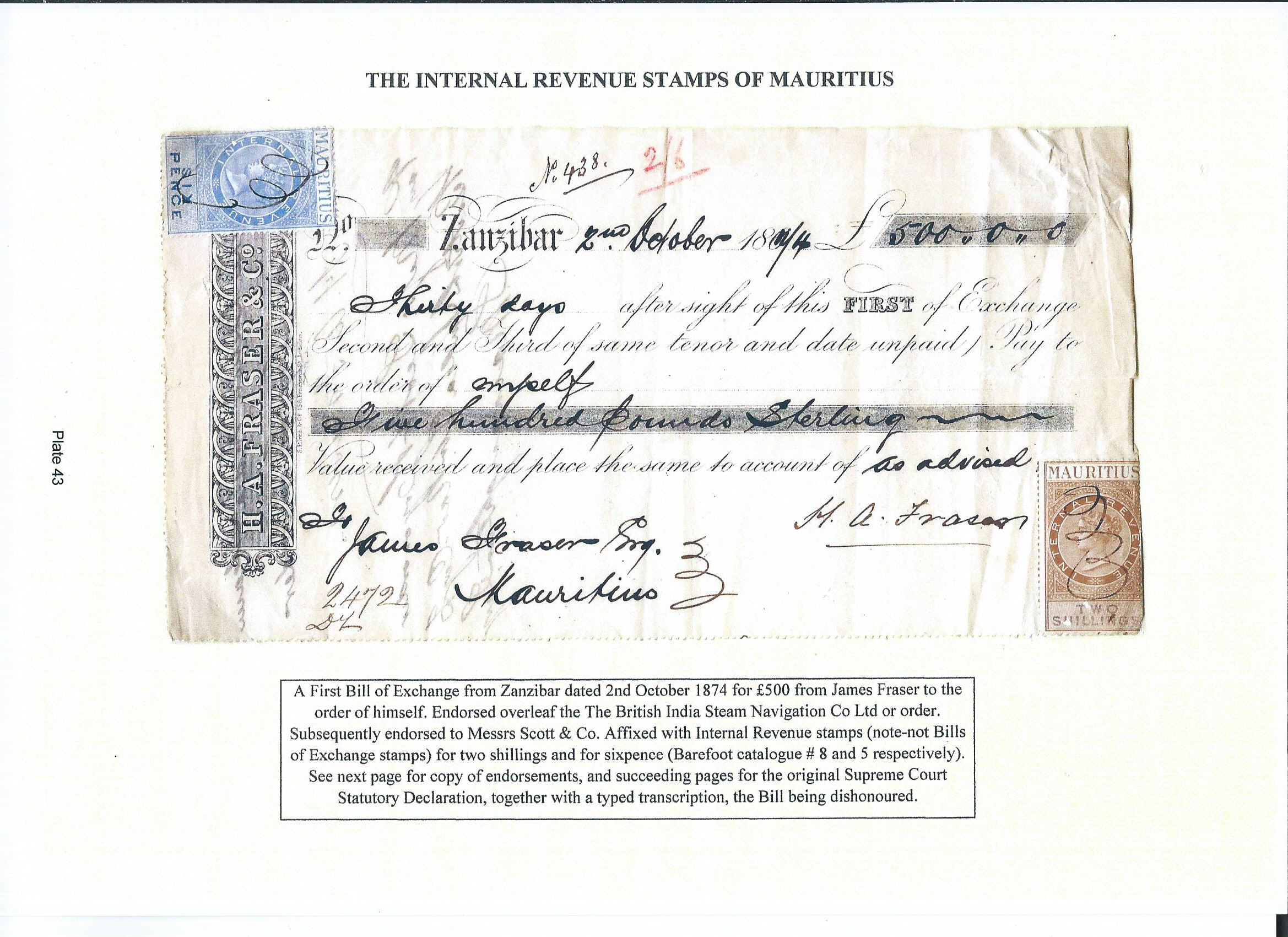
Plate 43 (click to
enlarge)
The second Plate shows the reverse of the bill, and demonstrates why
such documents are termed "negotiable instruments" i.e. the rights for
ultimate encashment against James A Fraser can be passed by one
person/firm to another, usually for goods or cash payment (often
discounted). In this case, the Bill has been "negotiated" twice. On the
face of the Bill it was first written in favour of Fraser himself, but
it can be seen that he endorsed it on to the British India Steam
Navigation Co Ltd who subsequently endorsed it to Messrs Scott & Co.
However, the story does not end here, because
Plate 45
displays the top page of three containing a Supreme Court Statutory
Declaration. Very faintly at the top left of the document, is the
impression of a Supreme Court duty stamp for three pence. These
impressed duty stamps do not copy well, and are even quite difficult to
see in poor light on the original document. The impression is repeated
on each of the three sheets, making total duty of nine pence. I have
attempted to show a typed transcription on
Plate 46 as
the manuscript is difficult to read and, even then, I have been unable
to understand some words where I have used a question mark instead.
Briefly stated, the Declaration was made by the Court Usher, who visited
James A Fraser for the purpose of getting him the honour the Bill, which
he refused to do. The Declaration could subsequently be used by Scott &
Co as evidence if they wished to bring a Court action against Fraser.
This whole story is an interesting insight into some aspects of
commercial life at that time in history. It was difficult to know in
what section of the book I should introduce this tale but, in the end,
the Internal Revenue stamps won against Bills of Exchange and Impressed
Duty Stamps!
Apart from the elusive 10 rupees brown and purple issue, which is
actually shown on the document on
Plate 51, the rest of
the 1878/79 stamps are shown on
Plate 47. These are the
first of the new currency, when rupees and cents in decimal form
replaced pounds shillings and pence. Values are expressed in a mixture
of figures and words. Some shades are shown as well, but these are not
so markedly obvious in the printing reproduction. However, the rather
unadventurous colours of earlier stamps continue to be used.
De La Rue plate proofs comprise
Plate 48, when in 1879
the values were changed to words only. Plates
49,
50,
51 and
52
show mint and used issues in use from 1879 to 1896, although not in
complete sets. Colour variety is much improved, and some shades are
shown in the used sections.
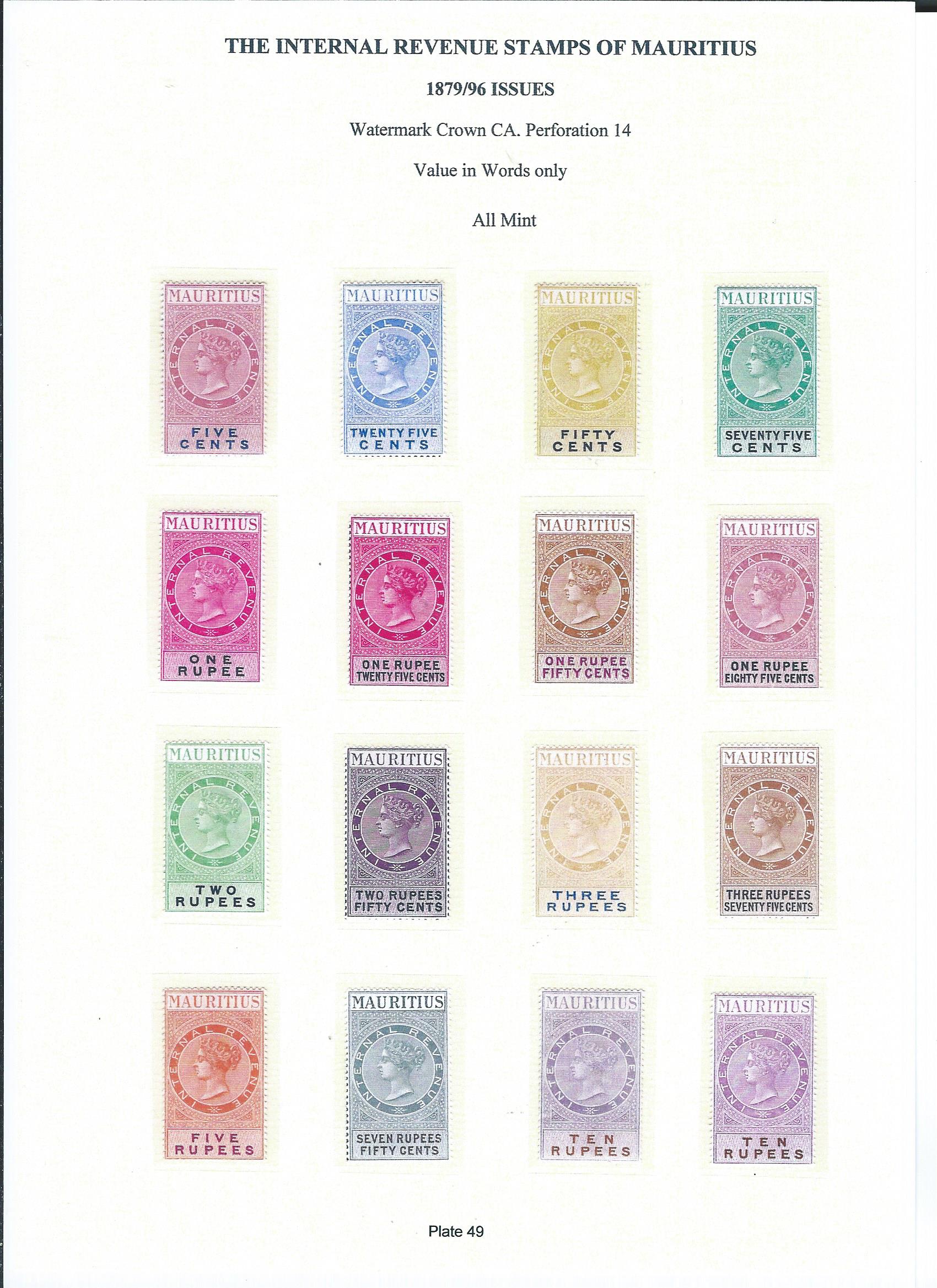
Plate 49 (click to
enlarge)
A mint block of four of the 10 rupees issue with inverted watermark is
displayed on Plate 50. This is not listed in Barefoot,
as it normally does not include such varieties, except where it is
planned or consistent.
I illustrate another Supreme Court Statutory Declaration dated 14
January 1880 which comprises four pages. I have shown the first page on
Plate 53, but refrained from showing the rest. There is
a transcript of the whole document on
Plate 54.
Although it cannot readily be seen on the scan there are impressed Court
Duty stamps on each page of twelve cents. This compares with the
previous document on
Plate 45 of three pence per sheet,
therefore reflecting the change of currency. The declaration itself is
in many ways similar to the previous one where a Bill of Exchange was
dishonoured, although the actual Bill itself is not part of the exhibit.
The Chief Judge's signature (A G Ellis) is shown halfway down the front
page, and his initials appear also on the Internal Revenue stamp for
five rupees, a third of the way down on the left hand side: in addition
on the left there is a red Supreme Court wax seal. The adhesive stamp is
Barefoot #46 brown and purple (1879/96 issue).
It is worth observing the procedures used to secure further supplies of
revenue stamps when these were necessary. Communications between
Mauritius and the United Kingdom were virtually all by ship, and
therefore when the authorities wanted more supplies they had to order
well in advance.
Plate 55 shows a letter from the
Colonial Secretary's Office in Mauritius addressed to The Crown Agents
for the Colonies at Downing Street London S W, and dated 12 April 1884.
As will be seen readily, this is a copy of the original letter. Although
it is hand-written, the oval receipt handstamp of the Crown Agents has
been roughly sketched in by hand in pen and ink, and is dated 8 May 1884
; so it took four days less than a calendar month to reach London.
This letter, and the subsequent related documents, are all extracted
from the De La Rue archive books. Attached to the letter is a copy of
the actual requisition from the Mauritius General Post Office dated 7
April 1884 and shown on
Plate 56. I believe that the
red ink markings were added by De La Rue to complete their records. the
blue twenty-five cents Internal Revenue stamp is an original also, I
suspect, added by the printers.
Why are these only copies, one may ask? The final exhibit in this set of
three documents gives the answer.
Plate 57 shows again
a copy. This time it is a letter from De La Rue to the Crown Agents
returning the Requisition, and providing an estimate of the time which
would be taken to produce the printed item.
So one can calculate that at least three months was needed from start to
finish of the whole operation. This example also illustrates how
significantly technology has advanced over the past 100 years plus, in
matters of printing techniques, copying, email, air travel etc.
Continuing with the 1879/96 issues,
Plate 58 dated 20
June 1885, and described as Appendix A, is an original from the De La
Rue archives showing perforated plate proofs of the lower values, none
of which were adopted in this form. De La Rue tended at this time to use
the doubly fugitive colours of purple or green on many of their basic
proofs of lower values. These colours were sometimes used on the final
stamps, and are notable on some of the Great Britain stamps of about
this time. These colours were sensitive to light and/or water, and many
examples of bad fading exist, reducing values dramatically.
Appendix A is somewhat larger than A4 size paper, and I have had to
transfer a copy of the handstamped date from the top of the sheet, which
has been folded over, to he right hand side about an inch and a half
from the top.
Between 1885 and 1896, many provisional surcharges on previous issues of
Internal Revenue stamps. Some of the original material dates back to the
Sterling period of production. This was obviously a good and economical
way to use up old obsolete and/or surplus stock. One also suspects -
although I have no concrete evidence of this - that thoughts had already
started on the possibility of combining the use of stamps for both
postage and revenue purposes: thus there was some reticence in ordering
new issues. Plates
59 and
60 display some of the mint
and used (with shades) overprinted stamps.
These are not so easy to find, as is supported by Barefoot's catalogue
prices. However, a full listing is shown, together with all the other
Internal Revenue stamps later in this section.
Proceeding to 1897, on 21 April a requisition was sent to De La Rue from
the Crown Agents, together with a letter on the same page. This is shown
on Plate 61. The requisition covers not only Internal
Revenue items but also Bills of Exchange and Insurance stamps: the
letter itself only refers to the three Internal Revenue supplies
required, and specifies changed colours.
The Appendix on
Plate 62 compiled by De La Rue shows
these rather attractive colours, and was approved by the Crown Agents on
27 April 1897. This seems to indicate that the stamps were not produced
in 1896, as indicated in the Barefoot catalogue, but in the subsequent
year.
Continuing with the 1879/96 issues, I illustrate a piece cut from the De
La Rue archives (cut rather badly I am afraid) showing a request from
the Crown Agents for further quantities of the 50 cents and R2.50 stamps
in yellow and black and violet and black respectively. These are on
Plate 63 and it can be seen that both stamps are
denominated "fifty cents". They are imperforate. This item is also shown
in black and white in Ibbotson's book "The Postal History and Stamps of
Mauritius" page 86.
Why the printers were still issuing plate proofs as late as 21 October
1898 is not clear. Whether this was instigated by them, or it came as a
request from Mauritius or the Crown Agents is not known. Nevertheless,
this Appendix shown on
Plate 64 displays imperforate
combinations of bistre, brick red and blue-green. The one Rupee value
tablets are printed in red, blue or greenish-blue. None of these were
adopted.
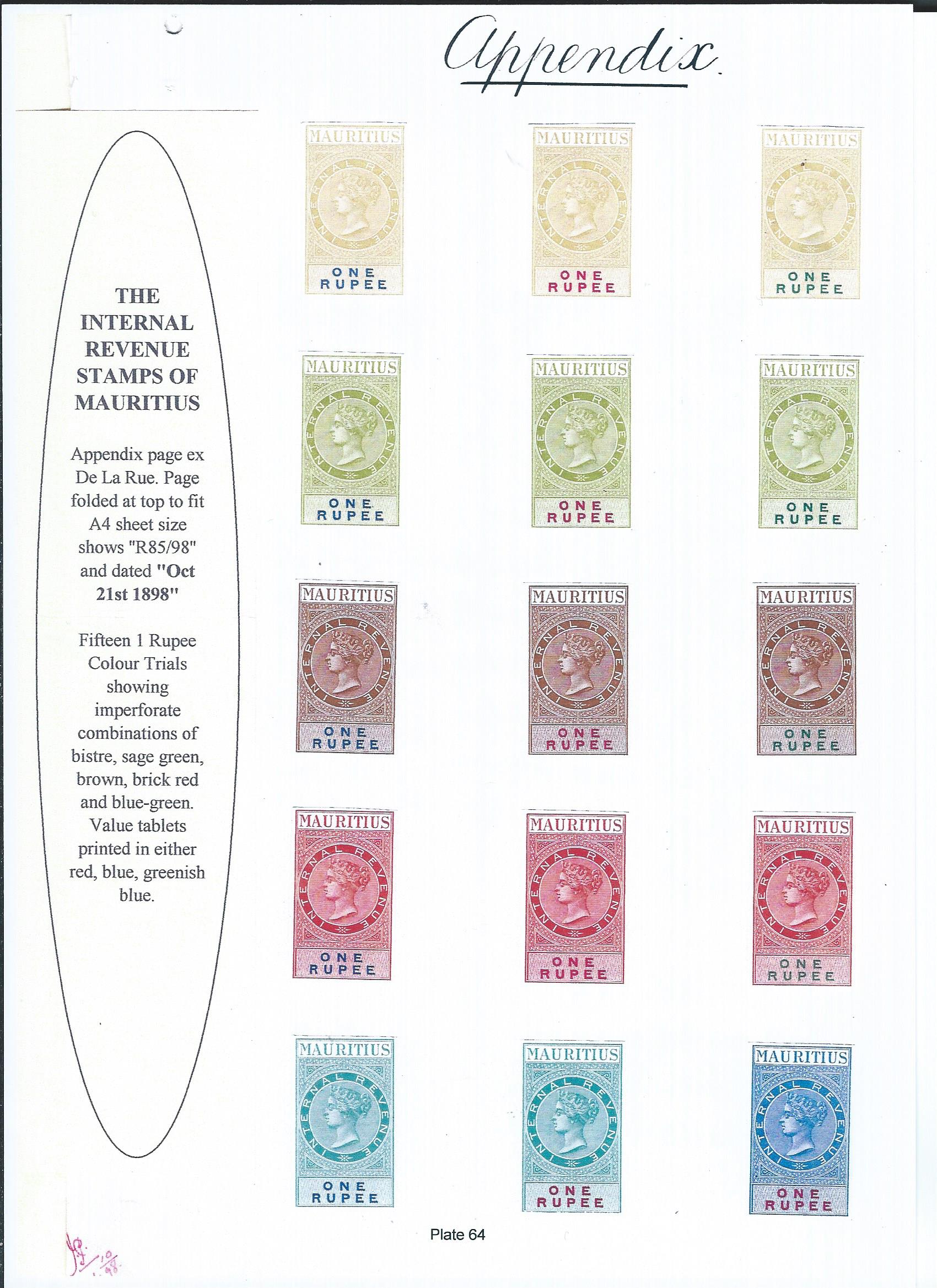
Plate 64 (click to
enlarge)
Another example of an original die proof is shown on
Plate 65,
and again this was not adopted. It was originally dated by De La Rue 17
November 1898, and cancelled by the red diagonal line on 14 January
1899, when it was decided not to go ahead.
The following schedules give similar details to those shown under the
Bills of Exchange section, but it is worth mentioning (although in some
cases it is obvious) that the statistics shown for dates and quantities
of sheets issued are incomplete. This applies not only to items where
"Not known" is shown, but also it is likely to extend to other items as
well, as it cannot be certain that all issues have been discovered.
But I do feel that the statistics do give some help in ascertaining the
approximate rarity of one stamp as opposed to another. For example,
rather extreme I admit, if one totals up the number of sheets issued of
the 25 cents blue and blue cat #30 below, one arrives at a total of
6,814 sheets or 408,840 actual stamps at 60 stamps per sheet. Compare
this with the 40 sheets at #47 - 2,400 stamps, and the first exceeds the
second by more than 170 times!
Schedule of Internal Revenue Stamps Issued
| Barefoot Cat No |
Stamp Value and Colour | Date and Quantity of Sheets Issued |
| 1869/72 issue | ||
| 1 | 1d claret and blue | 29.01.1872 : 527 |
| 1a | 1d claret and blue (perf
12.5) Note: Ibbotson states "Exceptionally, this printing comprised sheets of 120 stamps instead of the normal 60" It could be that the perforation change listed by Barefoot was occasioned by the change in stamps per sheet, although I have no evidence of this. |
22.08.1876 : 148 |
| 2 | 2d blue and blue | Not known |
| 3 | 3d blue and blue | 29.01.1872 : 521 |
| 4 | 4d blue and blue | Not known |
| 5 | 6d blue and blue |
29.01.1872 : 1026 20.12.1873 : 1033 |
| 6 | 8d blue and blue | Not known |
| 7 | 1s brown and purple |
29.01.1872 : 519 20.12.1873 : 1023 |
| 8 | 2s brown and purple | 29.01.1872 : 259 20.12.1873 : 1025 |
| 9 | 3s brown and purple | Not known |
| 10 | 4s brown and purple | Not known |
| 11 | 5s brown and purple | Not known |
| 12 | 10s brown and purple | Not known |
| 13 | £1 mauve and brown | Not known |
| 1874 issue | ||
| 14 | 14 6d blue and blue | Not known |
| 15 | 15 1s brown and purple | Not known |
| 16 | 16 2s brown and purple | Not known |
| 1878/79 issue
(new currency) Figures and words |
||
| 17 | 5c red and blue | 07.10.1877 : 243 20.03.1877 : 238 |
| 18 | 15c blue and blue | 07.10.1877 : 404 20.03.1877 : 404 |
| 19 | 25c blue and blue | 07.10.1877 : 1018 20.03.1878 : 986 |
| 20 | 50c brown and blue | 07.10.1877 : 502 20.03.1878 : 494 |
| 21 | 1r brown and purple | 07.10.1877 : 416 20.03.1878 : 398 |
| 22 | 1r50c brown and purple | 07.10.1877 : 103 |
| 23 | 2r brown and purple | 07.10.1877 : 74 20.03.1878 : 74 |
| 24 | 2r50c brown and purple | 07.10.1877 : 85 20.03.1878 : 78 |
| 25 | 5r brown and purple | 07.10.1877 : 55 20.03.1878 : 56 |
| 26 | 10r brown and purple | 07.10.1877 : 28 20.03.1878 : 26 |
| 1879/96 issue
as above but value in words |
||
| 27 | 5c red and blue | 27.04.1881 : 550 03.10.1884 : 250 30.07.1885 : 253 |
| 27a | 5c red and blue-black | 10.05.1886 : 500 16.08.1894 : 102 06.03.1895 : 1024 24.08.1900 : 200 18.09.1901 : 400 |
| 28 | 15c blue and blue | 11.08.1890 : 96 06.10.1891 : 103 04.04.1892 : 92 16.08.1894 : 102 25.06.1896 : 72 |
| 29 | 15c grey and black | 24.07.1897 : 204 |
| 30 | 25c blue and blue | 06.01.1883 : 402 05.06.1884 : 817 30.07.1885 : 608 10.05.1886 : 1010 24.07.1888 : 402 23.03.1891 : 253 06.10.1891 : 410 04.04.1892 : 400 20.07.1893 : 402 16.10.1894 : 400 06.03.1895 : 510 08.05.1896 : 500 30.04.1900 : 300 18.09.1901 : 400 |
| 31 | 50c blue and blue | 06.01.1883 : 203 03.10.1884 : 240 30.07.1885 : 410 04.04.1892 : 100 21.03.1893 : 85 30.12.1893 : 150 16.10.1894 : 305 |
| 32 | 50c yellow and black | 25.01.1898 : 506 16.01.1899 : 172 24.08.1900 : 150 18.09.1901 : 300 |
| 33 | 75c green and black | 06.11.1878 : 205 30.12.1893 : 102 06.03.1895 ; 102 |
| 34 | 1r brown and purple Note: No details are available of when #34 was changed to #35. The printings have therefore been shown under one heading for both issues. |
28.02.1884 : 96 |
| 35 | 1r brown and red | 30.07.1885 : 200 10.05.1886 : 250 06.10.1891 : 92 04.04.1892 : 92 30.12.1893 : 146 16.10.1894 : 203 08.05.1896 : 122 |
| 36 | 1r red and black | 14.07.1897 : 202 18.09.1901 : 60 |
| 37 | 1r25c red and black | 06.11.1878 : 152 30.12.1893 : 104 |
| 38 | 1r50c brown and purple | 30.12.1893 : 104 |
| 39 | 1r85c red and black | 06.11.1878 : 100 30.12.1893 : 100 |
| 40 | 2r brown and purple | 27.07.1882 : 103 03.10.1884 : 60 30.12 1893 : 104 |
| 41 | 2r green and black | 14.07.1897 : 100 |
| 42 | 2r50c brown and purple | Not known |
| 43 | 2r50 violet and black | Not known |
| 44 | 3r brown and blue | 16.01.1899 : 86 |
| 45 | 3r75c brown and black | 06.11.1878 : 52 |
| 46 | 5r brown and purple | 27.07.1882 : 86 10.05.1886 : 58 |
| 47 | 5r orange and purple | 16.01.1899 : 18 06.08.1901 : 22 |
| 48 | 7r50c grey and black | 06.11.1878 : 52 |
| 49 | 10r purple and brown | 27.07.1882 : 22 11.08.1890 : 12 03.09.1895 : 17 16.01.1899 : 18 06.08.1901 : 22 |
| Because all of the rest of this listing comprises overprinted surcharges of Internal Revenue stamps already produced, and hopefully recorded above, I merely list catalogue numbers and descriptions for the sake of completion in showing the whole of the Barefoot categories. | ||
| 1885/94 issue Provisional Surcharges |
||
| 50 | 15c on 4s | |
| 51 | 25c on 3d | |
| 52 | 25c on 6d | |
| 1886/94 issue Further Provisional Surcharges |
||
| 53 | 5c on 75c | |
| 54 | 15c on 1s | |
| 55 | 15c on 1r50c | |
| 56 | 25c on 6d | |
| 57 | 25c on 15c | |
| 58 | 25c on 75c | |
| 58a | 25c on 75c (dropped "c") | |
| 59 | 25c on 1r25c | |
| 60 | 25c on 1r50c | |
| 61 | 25c on 1r85c | |
| 62 | 25c on 1s | |
| 63 | 1r on 1r25c | |
| 64 | 1r on 2s | |
| 65 | 1r on 3s | |
| 66 | 1r on 4s | |
| 67 | 1r on 5s | |
Again, as with other Revenue stamps, the cancels are worthy of examination and collection. In analysing these, even more are indistinct than those on the Bills of Exchange material, although stronger magnification and assiduous application may decipher more than I have able to achieve. I have found the following firms etc:
-
B B & Co (Blyth Bros)
-
B B & Co (Perfin)
-
Bank of Mauritius
-
Elias Mallad & Co
-
Hajeew Hamode Ahoo & Co
-
Joosop Jacob
-
Manuscript cancels with signatures/initials/dates
-
Mauritius Commercial Bank
-
Mauritius First Insurance Company
-
New Oriental Bank Corporation
-
Oriental Bank Corporation
Undoubtedly, merchants are rarer than banks. This
somewhat surprises me, in view if the breadth of uses to which the
Internal Revenue stamps could be put. This may be because banks - and
possibly insurance companies - tended to keep their records better and
longer.
Another offshoot of study could well be to research products or
serviceshich, by Enactment of Parliament (either locally or in the
earlier days by the U K), were exempted from any or some form of duty.
One example of this is contained in the Mauritius Sugar Syndicate Act of
1951 which, inter alia, states:-
"8. Exemption from Duty
All sales of sugar made........ shall be free from stamp and other
duties except stamp duty on receipts, and shall be exempt from
registration."
This was obviously done to boost the declining sugar trade from the
island, but there could be other items within the Mauritius or British
Colonial legislation which showed special attention either to an
enhanced, decreased, or exempt level of taxation.